
At NRF 2026, Google introduced the Universal Commerce Protocol (UCP): an open standard that lets AI agents carry out steps of a purchase with retailers in a standardized way. The central point is a change of interface. Alongside the storefront (native or PWA/headless), a layer appears in which commerce is consumed through capability APIs for checkout, identity, and post-sale.
In parallel, OpenAI and Stripe are advancing with the Agentic Commerce Protocol (ACP), tied to Instant Checkout in ChatGPT.
For mid-market and enterprise operations on Adobe Commerce, the differentiator will be consistency of price, inventory, delivery time, and commercial policy, well-governed integration, observability, and predictable post-sale. Anyone already suffering from divergence between Commerce, ERP, and OMS will understand quickly: in the agentic world, those problems start to cost conversion.
01What Google signaled at NRF by launching the UCP
The UCP announcement at NRF this week is a clear message: the buying journey can happen where the intent is born, including inside AI experiences. Instead of taking the user somewhere to “click and browse,” the agent starts to assemble the purchase, ask for confirmations, and complete checkout.
For anyone using Adobe Commerce, that changes the strategic question. It is no longer only “how do we make the site faster?” It becomes:
“Is our Commerce purchasable by API from end to end?”
“Are total price, freight, and delivery time reliable in real time?”
“Can we operate post-sale (status, exchange, return) without friction?”
“Do we have an auditable trail and reprocessing control for transactions started by machines?”
The UCP puts that scenario into the form of a protocol. And that tends to pull investment toward what sustains programmatic buying: capabilities + operations + data.
02What agentic commerce is
Agentic commerce is when AI stops being only a “search engine” and starts executing actions: comparing products, building a cart, calculating freight, applying coupons, finishing checkout, and tracking the order.
The change in behavior comes from a simple shift:
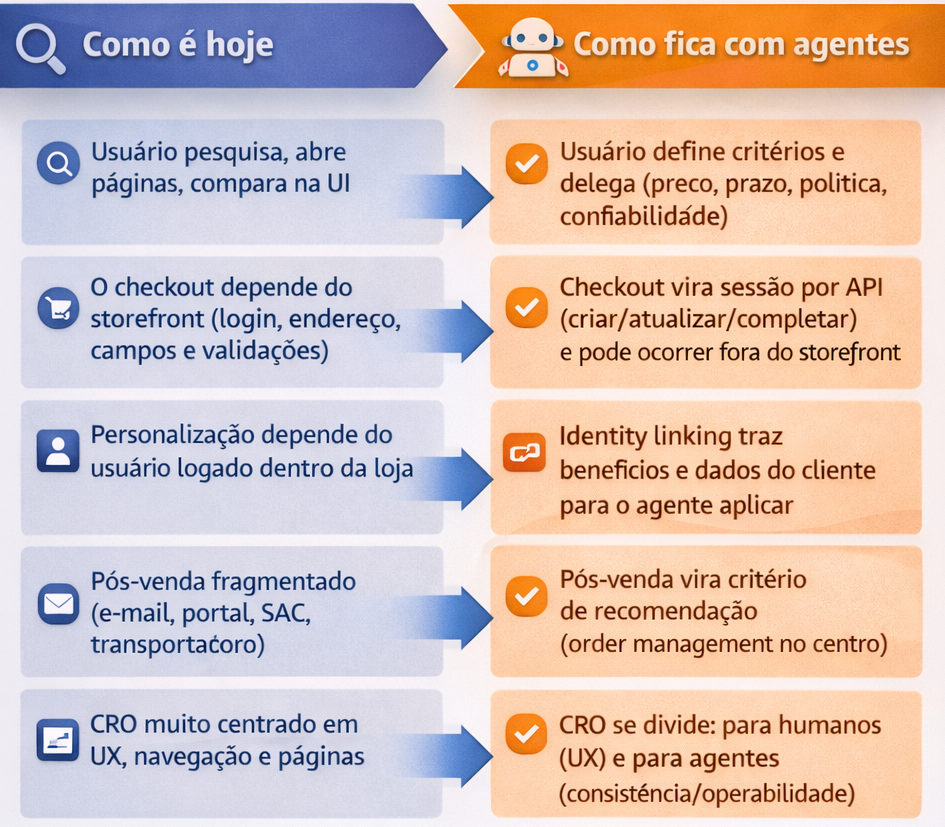
– Before: the user browses in order to decide.
– Now: the user sets criteria (price, delivery time, policy, reliability) and delegates the work.
That reduces clicks, lowers dependence on your layout, and raises dependence on what the agent can read and execute: structured data and stable APIs.
03Google’s UCP: what it is and how it works
The Universal Commerce Protocol (UCP) was created to standardize how agents interact with merchants along the journey and, in the initial launch, organizes the integration into three blocks:
1) Checkout and the “checkout session” concept
The UCP structures checkout around a checkout session: a state that represents the cart, totals, delivery and payment options, and the checkout lifecycle (create, update, complete, cancel).
For an Adobe Commerce team, that should sound familiar. It is what every serious headless project already tries to do: treat checkout as transactional state over an API, and as something other than a form coupled to pages.
2) Identity Linking
Identity Linking is the mechanism for binding the user to a merchant account (addresses, loyalty, preferences), with consent. In practical terms, the agent can apply “what is mine” at checkout without the user filling everything in again.
3) Order Management
Order Management covers post-purchase: tracking orders, states, support, and potentially exchange and return flows. That matters because, for an agent, “reliability” weighs as much as “price.”
Translation for Adobe Commerce: the UCP tends to pull investment toward consistency across the full order cycle. That implies integration with OMS, ERP, logistics, and so on, and with more than Commerce alone.
04OpenAI/Stripe ACP
The Agentic Commerce Protocol (ACP) is an open standard associated with the OpenAI/Stripe ecosystem to enable purchases started by agents, against the backdrop of experiences such as Instant Checkout in ChatGPT.
While the UCP has Google as a large “hub” of intent, the ACP serves the scenario in which intent is born (and completed) inside a specific agent. For enterprise operations, the practical effect is that there will not be a single dominant protocol from one day to the next. The more realistic picture is coexistence.
MCP Server at a glance
MCP (Model Context Protocol) is a standard for an agent to call external “tools” in a standardized way (as if they were functions). An MCP server exposes those tools, for example: “create checkout,” “recalculate freight,” “complete order.” In the ACP context, that means that, instead of the agent integrating with a custom REST API per company, it can call well-defined tools, with predictable inputs and outputs, reducing integration friction.
The changes in the digital environment
Technology changes go hand in hand with new behaviors adopted by consumers. These changes tend to affect a significant share of online buyers in the coming years. See the comparison below:
05What changes specifically for anyone using Adobe Commerce
1) Headless continues, and it stops being the “end”
Headless commerce projects remain relevant for performance, flexibility, and rich experiences. Headless becomes one consumer among others. The agent is another consumer, and that changes priority:
– Less focus on the “visual component” as the only differentiator
– More focus on a stable “capability”: checkout session, calculation, policies, post-sale
2) Checkout and transactional state move to the center
If checkout today is tightly coupled to the UI, the natural evolution is to make it more “session-based” and robust:
– recalculate without inconsistency;
– support updates;
– avoid duplication (idempotency);
– record an audit by session and order.
3) OMS/ERP and integration leave “project” and become “product”
In the enterprise, the difference between promising and delivering sits in the efficiency of integrating the whole ecosystem of peripheral systems (ERP, OMS, WMS, logistics, and so on). With agentic commerce, those integrations stop being an “invisible back office” and become part of what determines conversion.
4) Data and governance start to have a direct impact on revenue
An incomplete catalog, poor attributes, a confusing policy, inventory divergence, a badly calculated delivery time: all of that becomes “input for the agent.” Data governance stops being only a BI topic and becomes a commercial topic.
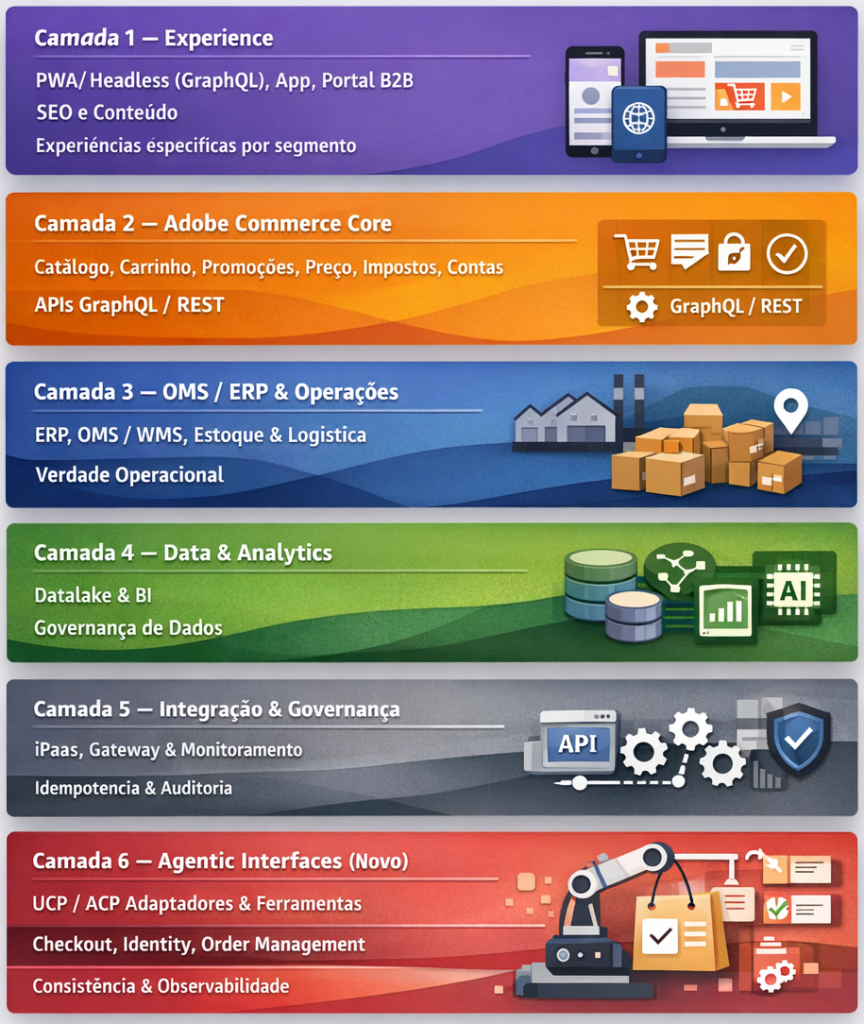
A mature commerce architecture on Adobe Commerce already separates layers. With agentic commerce, that separation becomes even more valuable. See the example below:
If your operation is mid-market or enterprise on Adobe Commerce or Magento and you want to understand where the gaps are between what your stack promises and what an agent can execute, DIGITAL HUB can help with a readiness assessment focused on architecture, data, integration, and operations.